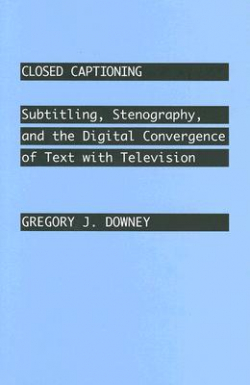
Closed Captioning: subtitling, stenography, and the digital convergence of text with television
Type
E-Book
Authors
Category
E-resources
[ Browse Items ]
Publication Year
2008
Publisher
The John Hopkins University Press, United States
Pages
ix, 400 p.
Subject
1. Stenography 2. Speech-to-text systems
Tags
Abstract
This engaging study traces the development of closed captioning―a field that emerged in the 1970s and 1980s from decades-long developments in cinematic subtitling, courtroom stenography, and education for the deaf. Gregory J. Downey discusses how digital computers, coupled with human mental and physical skills, made live television captioning possible. Downey's survey includess the hidden information workers who mediate between live audiovisual action and the production of visual track and written records. His work examines communication technology, human geography, and the place of labor in a technologically complex and spatially fragmented world.
Illustrating the ways in which technological development grows out of government regulation, education innovation, professional profit-seeking, and social activism, this interdisciplinary study combines insights from several fields, among them the history of technology, human geography, mass communication, and information studies.
Illustrating the ways in which technological development grows out of government regulation, education innovation, professional profit-seeking, and social activism, this interdisciplinary study combines insights from several fields, among them the history of technology, human geography, mass communication, and information studies.
Description
Acknowledgments vii
Introduction: Invisible Speech-to-Text Systems 1
Part One. Turning Speech into Text
in Three Different Contexts
1 Subtitling Film for the Cinema Audience 17
2 Captioning Television for the Deaf Population 53
3 Stenographic Reporting for the Court System 103
Part Two. Convergence in the
Speech-to-Text Industry
4 Realtime Captioning for News, Education, and the
Court 155
5 Public Interest, Market Failure, and Captioning
Regulation 199
6 Privatized Geographies of Captioning and Court
Reporting 244
Conclusion: The Value of Turning Speech into
Text 275
List of Abbreviations 301
Notes 303
Index 381
Introduction: Invisible Speech-to-Text Systems 1
Part One. Turning Speech into Text
in Three Different Contexts
1 Subtitling Film for the Cinema Audience 17
2 Captioning Television for the Deaf Population 53
3 Stenographic Reporting for the Court System 103
Part Two. Convergence in the
Speech-to-Text Industry
4 Realtime Captioning for News, Education, and the
Court 155
5 Public Interest, Market Failure, and Captioning
Regulation 199
6 Privatized Geographies of Captioning and Court
Reporting 244
Conclusion: The Value of Turning Speech into
Text 275
List of Abbreviations 301
Notes 303
Index 381
Biblio Notes
Note: Includes references and index.
Number of Copies
1