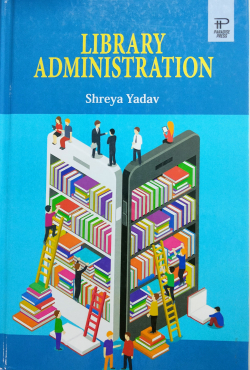
Library administration
Type
Book
Authors
ISBN 13
9789395337915
Category
Reference
[ Browse Items ]
Publication Year
2023
Publisher
Paradise Press, India
Pages
x, 261 p.
Subject
1. Library administration. 2. Library personnel management.
Abstract
Library administration means managing the performance of the operations and other activities of a library and then finally making important decisions. Administration can be defined as the act or process of administering, especially the management of a government or large institution in order to achieve the goals and objectives.
Management and administration may seem the same, but there are differences between the two. Administration has to do with the setting up of objectives and crucial policies of every organization. What is understood by management, however, is the act or function of putting into practice the policies and plans decided upon by the administration. Administration is a determinative function, while management is an executive function. It also follows that administration makes the important decisions of an enterprise in its entirety, whereas management makes the decisions within the confines of the framework, which is set up by the administration.
Administration usually handles the business aspects, such as finance. It may be defined as a Notes system of efficiently organizing people and resources, so as to make them successfully pursue and achieve common goals and objectives. Administration is perhaps both an art and a science. This is because administrators are ultimately judged by their performance. Administration must incorporate both leadership and vision.
The primary objective of any library system is to collect, store, organize, retrieve and make available the information sources to the information users. A library, as a system, is a subsystem of some super-system (an organization in any field, whether education, research or social service). It has its own subsystems, such as, acquisition system, circulation system, administration system, etc.
Libraries have an important role to play in facilitating access to information for learning, education and training. It is a known fact that a well-managed library is a successful library. The library management means efficient and effective management of material (information sources), machinery, men (human resource), technology and money to meet the objectives of the library. Thus, librarian as manager performs all the functions of manager/administrator.
The library administration and management are gaining the attention of today's urban library administrator. Some do not have clear or easy solutions since they are part of a large and involved issue. In turn, some of the main library problems are themselves interrelated with the local library operation. For years library administration had a passion for classical bureaucratic uniformity in service to all users, sometimes regardless of special need. With any rigid system of uniformity it becomes difficult to separate the parts from the whole. While the thoughts in this article purposely do not have continuity, they all relate to issues which affect the future of main library operation.
The book presents research, developments, and trends in the leadership, administration and management libraries.
--Author
Management and administration may seem the same, but there are differences between the two. Administration has to do with the setting up of objectives and crucial policies of every organization. What is understood by management, however, is the act or function of putting into practice the policies and plans decided upon by the administration. Administration is a determinative function, while management is an executive function. It also follows that administration makes the important decisions of an enterprise in its entirety, whereas management makes the decisions within the confines of the framework, which is set up by the administration.
Administration usually handles the business aspects, such as finance. It may be defined as a Notes system of efficiently organizing people and resources, so as to make them successfully pursue and achieve common goals and objectives. Administration is perhaps both an art and a science. This is because administrators are ultimately judged by their performance. Administration must incorporate both leadership and vision.
The primary objective of any library system is to collect, store, organize, retrieve and make available the information sources to the information users. A library, as a system, is a subsystem of some super-system (an organization in any field, whether education, research or social service). It has its own subsystems, such as, acquisition system, circulation system, administration system, etc.
Libraries have an important role to play in facilitating access to information for learning, education and training. It is a known fact that a well-managed library is a successful library. The library management means efficient and effective management of material (information sources), machinery, men (human resource), technology and money to meet the objectives of the library. Thus, librarian as manager performs all the functions of manager/administrator.
The library administration and management are gaining the attention of today's urban library administrator. Some do not have clear or easy solutions since they are part of a large and involved issue. In turn, some of the main library problems are themselves interrelated with the local library operation. For years library administration had a passion for classical bureaucratic uniformity in service to all users, sometimes regardless of special need. With any rigid system of uniformity it becomes difficult to separate the parts from the whole. While the thoughts in this article purposely do not have continuity, they all relate to issues which affect the future of main library operation.
The book presents research, developments, and trends in the leadership, administration and management libraries.
--Author
Description
Contents:
Unit I: Library administration and management systems
Unit II: Technology and library management
Unit III: Administration of book budget
Unit IV: Administration of circulation services
Unit V: Managing administrative metadata
Unit VI: Authority in library
Unit VII: Functions of acquisitions
Unit VIII: Managing library staff development
Unit IX: The scientific bases of archives administration
Unit X: Library finance: new needs, new models
Unit I: Library administration and management systems
Unit II: Technology and library management
Unit III: Administration of book budget
Unit IV: Administration of circulation services
Unit V: Managing administrative metadata
Unit VI: Authority in library
Unit VII: Functions of acquisitions
Unit VIII: Managing library staff development
Unit IX: The scientific bases of archives administration
Unit X: Library finance: new needs, new models
Biblio Notes
Notes:
Includes bibliographical references and index.
Includes bibliographical references and index.
Number of Copies
1