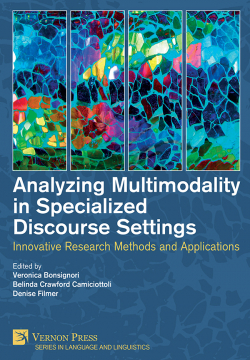
Analyzing multimodality in specialized discourse settings: innovative research methods and applications
Type
E-Book
Authors
LCCN
2021947359
Category
E-resources
[ Browse Items ]
Publication Year
2022
Publisher
Vernon Press, United States
Pages
xxiv, 200 p. : ill.
Subject
1. Language Arts & Disciplines 2. Linguistics--General 3. Multimodal discourse
Tags
Abstract
Contemporary society has witnessed radical changes in the field of communications in terms of how messages and meanings are disseminated. Digitalization and the Internet have signalled an exponential rise in the circulation of multimodal texts in which different semiotic resources are orchestrated together to construct meaning in all areas of social life, across languages and cultures, and in diverse specialized discourse domains. This has foregrounded the need to examine the semiotic functions, affordances, and issues at stake in a range of multimodal discourse forms, while simultaneously highlighting the importance of critical multimodal literacy in audiences and learners.
This volume develops and extends pioneering research on the intersection between multimodality and specialized discourse. Seven newly commissioned studies offer innovative perspectives on multimodal research methodologies and applications in a variety of ESP (English for Specific Purposes) contexts for practitioners and scholars alike. The volume offers a glimpse at future directions in this dynamic and ever-evolving area of investigation focusing on the synergy between verbal and non-verbal modes of communication in the digital age. Each chapter explores an original area of application: academic, economic, scientific, marketing, legal, medical, and political. The contributors approach multimodality from a range of theoretical and methodological viewpoints including synchronic and diachronic corpus-based and corpus-aided studies, critical discourse analysis, and systemic functional linguistics. Analytical tools such as multimodal (critical) discourse analysis, multimodal transcription, and multimodal annotation software capable of representing the interplay of different semiotic modes - speech, intonation, direction of gaze, facial expressions, gesturing, and spatial positioning of interlocutors - are employed. The diversity of research strands contained in the volume illustrates just some of the vast areas of multimodal knowledge dissemination that are still unmapped. As a cornerstone of communication, multimodality needs exploring in all its facets. These contributions aim to further that cause.
This volume develops and extends pioneering research on the intersection between multimodality and specialized discourse. Seven newly commissioned studies offer innovative perspectives on multimodal research methodologies and applications in a variety of ESP (English for Specific Purposes) contexts for practitioners and scholars alike. The volume offers a glimpse at future directions in this dynamic and ever-evolving area of investigation focusing on the synergy between verbal and non-verbal modes of communication in the digital age. Each chapter explores an original area of application: academic, economic, scientific, marketing, legal, medical, and political. The contributors approach multimodality from a range of theoretical and methodological viewpoints including synchronic and diachronic corpus-based and corpus-aided studies, critical discourse analysis, and systemic functional linguistics. Analytical tools such as multimodal (critical) discourse analysis, multimodal transcription, and multimodal annotation software capable of representing the interplay of different semiotic modes - speech, intonation, direction of gaze, facial expressions, gesturing, and spatial positioning of interlocutors - are employed. The diversity of research strands contained in the volume illustrates just some of the vast areas of multimodal knowledge dissemination that are still unmapped. As a cornerstone of communication, multimodality needs exploring in all its facets. These contributions aim to further that cause.
Description
List of figures
List of tables
Foreword
Marina Bondi
University of Modena and Reggio Emilia, Italy
Preface
Belinda Crawford Camiciottoli
University of Pisa, Italy
Veronica Bonsignori
University of Rome “Foro Italico”, Italy
Denise Filmer
University of Pisa, Italy
Chapter 1
Corpus-assisted Approaches to Online Multimodal Discourse Analysis of Videos
Anthony Baldry
University of Messina, Italy
Deirdre Kantz
University of Pavia, Italy
Chapter 2
Video Abstracts in EMP: A Corpus-Based Approach to the Analysis of Rhetorical Structure in Multimodal Medical Genres
Francesca Coccetta
Ca’ Foscari University of Venice, Italy
Chapter 3
The I-you Connection in Humanities and Social Sciences Lectures: Multimodal Insights
Belinda Crawford Camiciottoli
University of Pisa, Italy
Chapter 4
Using Google Talks in ESP Educational Settings: A Multimodal Approach
Elisa Mattiello
University of Pisa, Italy
Chapter 5
Representations of the Ideal Workplace in Multimodal Texts: Employer Branding on the Career Pages of Corporate Websites
Costanza Cucchi and Francesca Seracini
Università Cattolica del Sacro Cuore of Milan, Italy
Chapter 6
“What are Miranda Rights?”: The Case of Video FAQs on a Criminal Law Firm Website
Gianmarco Vignozzi
University of Pisa, Italy
Chapter 7
“As my Right Honourable Lady knows…”: A Multimodal Critical Discourse Analysis of Prime Minister’s Question Time Comparing Margaret Thatcher and Theresa May
Veronica Bonsignori
University of Rome “Foro Italico”, Italy
Denise Filmer
University of Pisa, Italy
Contributors
Index
List of tables
Foreword
Marina Bondi
University of Modena and Reggio Emilia, Italy
Preface
Belinda Crawford Camiciottoli
University of Pisa, Italy
Veronica Bonsignori
University of Rome “Foro Italico”, Italy
Denise Filmer
University of Pisa, Italy
Chapter 1
Corpus-assisted Approaches to Online Multimodal Discourse Analysis of Videos
Anthony Baldry
University of Messina, Italy
Deirdre Kantz
University of Pavia, Italy
Chapter 2
Video Abstracts in EMP: A Corpus-Based Approach to the Analysis of Rhetorical Structure in Multimodal Medical Genres
Francesca Coccetta
Ca’ Foscari University of Venice, Italy
Chapter 3
The I-you Connection in Humanities and Social Sciences Lectures: Multimodal Insights
Belinda Crawford Camiciottoli
University of Pisa, Italy
Chapter 4
Using Google Talks in ESP Educational Settings: A Multimodal Approach
Elisa Mattiello
University of Pisa, Italy
Chapter 5
Representations of the Ideal Workplace in Multimodal Texts: Employer Branding on the Career Pages of Corporate Websites
Costanza Cucchi and Francesca Seracini
Università Cattolica del Sacro Cuore of Milan, Italy
Chapter 6
“What are Miranda Rights?”: The Case of Video FAQs on a Criminal Law Firm Website
Gianmarco Vignozzi
University of Pisa, Italy
Chapter 7
“As my Right Honourable Lady knows…”: A Multimodal Critical Discourse Analysis of Prime Minister’s Question Time Comparing Margaret Thatcher and Theresa May
Veronica Bonsignori
University of Rome “Foro Italico”, Italy
Denise Filmer
University of Pisa, Italy
Contributors
Index
Biblio Notes
Note: Includes references and index.
Number of Copies
1